Monday, April 28, 2014

Fieldtrip! Farmville 2, Skyrim, and... beyond...

So, as you may have surmised having perused the contents of this blog, all of the posts have been assignments in a English class. However, it has been a quite enjoyable class, one where I feel like I have gained some interesting perspective. When I started the class, I must admit I somewhat mocked the premise. I mean really.... how much farming literature can there even be out there? I remember when I told a co-worker about it, her first response was "So... something like 'Old McDonald had a farm' would be what you are studying?" However, as I have delved more into this course, I have learned a lot, and feel like I have a much deeper appreciation for farming, and that appreciation was entirely attained due to studying literature about farmers, by farmers, and related to agriculture in general. I had no idea that farming could be so interesting.

On the other hand, it would seem that the idea that farming is somehow boring is a idea that has never really made a lasting impact on the world. Take a extremely popular game on Facebook right now... Farmville 2. Based on the original Farmville, and part of a series of "ville" games, this game helps any user gain an appreciation for farming, and enjoy themselves quite thoroughly. As far as for me, my wife is actually the one that initially got into the game, I am really not sure how. I think she was playing a different game once or twice, and there was some promo about getting something in the game if she made a farm. So, she started playing it, and got hooked quickly. Down the line, she started needing to request things from friends (as anyone who has a Facebook account knows... Farmville requires a lot of requests, but more on that later), and it was a convenient idea to create a farm under my profile so she could send requests to me, and not pester the rest of her friends with frequent requests. I was fine with it, so long as it didn't show up on my Facebook news feed for others to see (Farmville has a weird rapport attached to it...) One day, I was on Facebook, and my wife needed something from my "farm" so she asked if I could get on and send it to her. I obliged, then as I started looking around, I noticed that the game looked interesting. I had (lovingly) mocked her a few times for playing the game... but then I realized in a most certainly NOT farm related, "hardcore gamer" game, I was.... farming. In playing the game "Skyrim", I had built a home, and along with that, had some land to "till". I was growing various items that I could use in the game for my benefit. 
My little Skyrim garden.


Wheat growing in Skyrim
Lavender in my farm in Skyrim
Throughout the game, you are wandering through various areas, and you can pick plants. These plants can be used for all kinds of things, whether medicinal or for poisons, or other more mystical things. Now, as I am looking at this game with the theme of farming... I am amazed at how realistic the farming theme is. You find seeds, you plant and cultivate them, and the end result is similar, but not identical to that which you find in the wild. In Skyrim, the automatic result is a superior plant, but in reality the results are not always so predictable. Anyway, as I realized I was already "farming" for fun, I thought I'd give Farmville 2 a shot.


My farm. Surprisingly, it has taken a lot of hours to get it to this point. 
As I have played, I have been surprised by the complexity of the game, as it relates to farming. Mind you, my perspective on farming is entirely limited to literature, movies, and a little bit of yard work and gardening I have done, but from what I do know of farming, the developers have done a good job of balancing fun and virtual reality.

I want to go through some of the aspects of farming that I have noticed seem to be held true in this game, and then mention a few things where reality was lacking.

One positive aspect is the community aspect. Virtually every time you turn around, you have people in the game offering you things and asking you for things. These are both real people, as well as computer generated individuals who are there to make the game more dynamic. You can request people to come help on your farm, and you can even go help a neighbor out by volunteering on their farm. As the game continues to develop (one major advantage that "casual" games have over "hardcore" games.) the developers are continuing to add more aspects to the community. There is even a weekly county fair where you can win prizes for having bigger and better produce than your friends.

Another thing that I find interesting is the built-in resource caps. When you start out, you have very few options, and very little in-game money to spend on crops and tools. You have to earn your way up, and be able to purchase better and better seeds that produce more lucrative crops. You also earn more opportunities to make more types of produce from your crops. The game also has a designed system of trade. Now, some of this is obviously an opportunity for the game designers to generate some inflow of cash, however, it is true that in farming in order to make a bigger farm, you often have to spend money. In this game, if you want to accelerate your progress, you would have to do just that: fork out some (real!) money.

The growing system is interesting as well, as different crops take different amounts of time to grow, and the developers even have seasonal crops which you can't plant most of the year, unless they are running their promotion on them. Yes, there is little reality in the fact that it takes one minute to grow tomatoes, but it is still fun to be able to do some things quickly.

The animals are another really interesting addition to this game. As you gain animals, you notice that they are not only useful for their primary characteristics (cows and milk, chickens and eggs.) but they also can produce secondary resources as well (such as fertilizer). This adds a interesting aspect where you can see why farmers have such a connection to their animals, the animals do so much more than produce a single item, they sustain and help grow the farm!

Now, there are other areas where reality does abound, and is expounded upon, however, I want to focus on a few things this game lacks. There is no disease at all. The only way your crops can die is if you don't tend to them in time, and only in a game such as this can you not feed a cow for a few months, and have it still be happy and healthy when you return to it. The weather patterns have no effect on your farming either (other than to make it look pretty), but I can see why the developers have chosen that route.. who would play a farming game where you have a six month period in which you can't actually farm?

I have talked to my wife a few times about what draws her into the game, and I have gotten some interesting feedback from her; "Even though I know I am wasting time, it doesn't feel like it. Because I am meeting goals and producing things, I feel like I am actually getting something done, but with no effort." *(I feel like I need to put a caveat in here. My wife is a high school teacher at a year round school, and can spend about 50-60 hours a week on work all year... no summer break.... wasting a little time is O.K. for her to do). Speaking to her a little more, she also indicated some of the same things I had previously mentioned, that the wait time for plants, the community aspect, and other aspects of the game give it a more "real" feel. Asking her what drew her to the game elicited this response: "I think the fact that I get to achieve goals makes me want to come back. If it was just planting and growing things, I don't think I would have kept playing. However, because I actually have things I can accomplish in the game, I want to go back and play more."

All in all, it is interesting how much agriculture can exist in a game, and in the case of Skyrim, it is interesting to note that it has even worked it's way into some more graphic-intensive, "Game of the Year" games made by major developers.

sources:
Farmville 2. 2012. Zynga Games. San Francisco, California. Online game. 4/28/2014
Skyrim. 2011. Bethesda. Rockville, Maryland. PC. 4/28/2014
Kimberly Hawks

Sunday, April 6, 2014

Rhetorical Kinkade

I have always enjoyed the art of Thomas Kinkade. My mom has a penchant for lighthouses, and she has always loved his renditions of those. I grew up with his art around the house, so I grew quite accustomed to his soft pastel style. While crashing shorelines with warning towers were my mom's favorite pieces, I had noticed over time that Mr. Kinkade has a lot more variety to offer. When an opportunity came to analyze some art for my farming literature class, he seemed like an excellent choice. I chose a piece named Sunset at Riverbend Farm
Sunset at Riverbend Farm 

This painting shows a very peaceful setting for a farm. It looks to be more the type of farm one would want to retire to, or live off of, rather than the industrialized farms that feed hundreds and thousands. The painting was done by Thomas Kinkade in 1996. He resided in the United States, and this particular painting (as most of his are) is oil on canvas. The original size was 18x27

It seems that Mr. Kinkade had a more etic view of farming, as his focus is far more on the visual aspects than the meaning behind the farming. This painting is beautiful, but the relative lack of movement indicates a sleepy farm where nothing really gets done, quite different from the perspective I have gotten from a lot of the literature we have studied thus far this semester. This actually connects to one of the criticisms I read about Thomas Kinkade. It seems that other professional artists have a bit of disrespect for his art, seeing it more as kitsch that one would find in a old ladies home than a "real" piece of art. I have always been more of the school of thought that the value of the art has more to do with the perspective of the beholder. 

However, from the perspective of a farmer, this painting would probably not be very representative of what they consider to be farming. They might see the lack of specific crops, and question why there was not more land being utilized for planting crops. It is also obvious from the painting that this farm is not one designed for productivity, and has a lot more of a Thoreauian feel to it, where one would toil away in the small field for the greater part of the day, never sowing much, and not having enough farm to really "work". I don't know that a farmer would find this to be beautiful, or a laughable construct that attempts to recreate a very idyllic version of a farm. Either way, I think it is pretty, and that to me can be the main point of art. 

Kinkade, Thomas, Sunset at Riverbend Farm, 1994, Oil on canvas. 

Saturday, March 22, 2014

The Grapes of Wrath: How it must have felt to be an "Okie"

In The Grapes of Wrath, farming was a predominant theme. Being a psychology student, however, I tend to focus on the human side of things. When watching the movie, I noticed that the main characters, the Joads, were often put into difficult situations. From what I know of the time period, their experience would be quite representative of other farming families from Oklahoma at the time. Observing the varying situations the Joads found themselves in, I noticed several aspects of the human side, and how their farming culture affected them, making them react in slightly different ways than most people would have. In this post, I will be focusing on several different situations, showing how it felt to be a farmer in these situations, how they reacted, and how others around them reacted.

One of the first things the farmers had to deal with was the fact that their sharecropping days ended without their consent or knowledge. In the beginning of the movie, Tom Joad came home to a deserted house, to hear terrible stories of people being “Pushed off” and being forced to “Get Out” by the banks. While no human being likes being told what to do, much less leave something they love and have worked hard for, the farmers had a particular reaction. Someone from a more urban society would have been angered by the fact that they were not being compensated for their land and home. These humble farmers had a different reaction. They were depressed and saddened by the thought of leaving home. They felt like a part of their humanity was being torn away, and they attempted to fight back, but understood reason that the people doing the “Pushing off” were not the decision makers, but just pawns in this large game which they did not understand. While some of these farmers took this as an opportunity to find other fields of work, most of them decided to stay in the same line of work, and look for employment elsewhere. Because of their willing attitude, and ability to work hard, they saw the handbills from California promising work as exciting pieces of news that gave them hope. With much anticipation, they packed up their belongings, and left their homes behind. However, this must have been absolutely heart wrenching, as was shown in a scene where Grandpa Joad refused to leave his home of 70 years. Sobbing on the dusty ground, he picked up handfuls of dirt, and declared to the unrelenting wind: “This is MY country, and I belong here! This is MY dirt! It’s no good, but it’s mine!”

The reality of this situation was the fact that the farmers were not seen as people by the larger corporations who took ownership of the land. I’m sure if you asked an executive directly, they would acknowledge the humanity of the farmers, but there was a lot of symbolism contrasting the haves and have-nots. Whenever the representatives of the banks, employers, or landowners would show up, they always were dressed impeccably in nice suits, driving high end automobiles, and always were accompanied by an authority figure, usually a deputy or sheriff. This underscored the fact that the farmers simply were not in charge, and had to do what they were told, or suffer the consequences. There was also emotional connection to the arrival of those in charge. There was a definite dark, hopeless, foreboding feeling whenever the nice automobile drove up, you knew that something bad was bound to happen.

As the film progressed, there was a scene where lots of hopeful farmers were gathered together; they were having an enjoyable time, listening to music, singing, and just enjoying what would be expected of a farming community who had the deep sense of brotherhood that was portrayed so well. There was one, however, who had been to California, and back, and he was warning everyone not to go. He tried explaining to them the dangers and disappointment they would encounter, but no one wanted to listen to him. This makes sense for a lot of reasons, but mainly because it was one of the last pieces of hope the farmers had to hold on to. Most of the farmers reacted negatively, and refused to believe anything, and even justified his news as reality for him, but not for them.

The migrant workers, who were called “Okies” by everyone else, had a certain amount of prejudice following them wherever they went. The Joads encountered this multiple times throughout the movie. Their first encounter with this prejudice was a mixed one. As often happened, at least at first, there were times where people had preconceptions and prejudices about “Okies”, but once dealing with them directly, their tone changed, and their human side shone through with compassion. There is a scene with a diner, where the waitress is particularly vocal about her irritation and distaste of the migrants, but then, after interacting directly, she changes her tone, and helps. She even goes as far as to lie about the price of some candy, and sell it for less than it was worth. Because of her example, some truck drivers turn the deed back to her, and give the store their change that was due back to them. The Joads are oblivious to a lot of what is going on, and don’t understand why they were being dealt with harshly in the first place. They are extremely polite and kind to the waitress, even when she was being quite rude to them.

Through the rest of the movie, as times get worse and worse for the Joads, as well as the rest of the “Okies”, there is a constant foreboding sense of doom. Losing the farms made the farmers feel like they lost some of their humanity. There is a sense of emptiness, a sense of everything being too close. Farmers tend to be collectivist, when they moved to California; they had to face the reality of every man for themselves. They tried to still be the good people they believed they were, but the situations they were forced to be in often took over. The Joad family slowly falls apart, through a few deaths, desertions, and finally, when Tom had to leave because he had committed what was a justified crime, even though the law did not see it that way, and did not want to damage the family any further. It is shown over and over again that the Okies are just trying to get by, and have a sense of community, but the Californians (at least the ones they end up interacting with) tend to have more of a disposable view of the migrant workers.

Through it all, they learned how to persevere. Near the end of the movie, there was a conversation about fear, and how life just keeps on going, and it is best to go on, and that a beating makes you tough. With the final statement of “We are the people.” The movie drew to a close. The final scene was a long line of cars, but this line was hopeful somehow. Maybe as a result of the line, maybe the cinematography, but it left a strong feeling of resolve. Even through deep trials and hardship, these humble farmers were willing to persevere, learn from their problems, and toughen out even the worst of humanity. 

Works Cited:
1.       The Grapes of Wrath. Dir. John Ford. Perf. Henry Fonda, Jane Darwell, John Carradine, Charley Grapewin, Doris Bowden, Russell Simpson, O.Z. Whitehead, John Qualen, Eddie Quillan, Zeffie Tilbury. 20th Century Fox, 1940. Internet based Streaming video.  (Netflix)

Saturday, March 1, 2014

Code of Federal Regulations, Title 9: Part 317... a good law

For this blog post, I am happy to announce that there is a agricultural law that benefits me HUGELY. Let me preface this blog by a small story: I am overweight. I have been for years, and for years, I have done nothing but gain weight. I had tried all sorts of diets/exercise combos, and had even attempted a few "miracle pills", but nothing worked, I would always lose, then gain far more than I had ever lost. A little less than a year ago, however, I finally decided to give Weight Watchers a try. I have had a great amount of success. In the last year, I have lost 40 lbs, which is amazing, because for the 10 years previously, I had gained an average of 16-20 lbs per year. That is a net gain, including "weight loss" attempts. This is my first year in the last decade where I have had a net loss. I still have a ways to go, but I have confidence that I will be able to continue losing weight until I am at my desired size.

How does this relate to farming and agriculture you might ask? Well... quite simply, there is a regulation on food manufacturing that requires proper labeling and disclosure of ingredients (as mentioned in the title to this post), as well as caloric content, and grams of fat, protein, carbohydrates, and fiber. The researchers at Weight Watchers have determined that those four key elements are the basis for weight loss (or weight gain). As a result, they have determined a "points" system that is derived from the percentages of those food components. Now, me, the end user, simply have to input how much fat, carbohydrate, fiber, and protein a specific food has in a serving, and voila! I know how many "points" it is, and I can easily determine what is a healthy portion for me, as well as measure a serving easily. Because of the required labeling of most foods, I can easily determine what I want to eat, without being restricted to specific food designed and sold by a weigh loss company (which are inevitably difficult to enjoy), giving me the freedom to eat what I want, which is the main factor which has kept me on this diet.
Example of the current food labels required by the FDA, as well as proposed changes to this model.
So I would like to say a resounding THANK YOU to the FDA as well as Weight Watchers. I would not have been able to lose weight without your efforts!!

Saturday, February 15, 2014

Farming roots of Country Music: Carrie Underwood

I Ain't in Checotah Anymore by Carrie Underwood on Grooveshark
Country music means a lot of things to a lot of people. Some people instantly cringe when they hear the drawl and fiddle, some people jump up and start singing along. Personally, I have had multiple experiences with it. I used to despise country music, somewhere along the line, I started tolerating it, and now I actually have a few favorites from the genre. Carrie Underwood is one of my favorite artists. A lot of her music has heavy influence from her upbringing in rural Oklahoma. This is especially apparent in her song "I Ain't in Checotah Anymore" In this song, she makes a lot of stark contrasts between what she is used to in her earlier rural life, and her current "big city" stardom. On the other hand, I have a slightly backwards experience, from moving from a largely populated area with 5 lane freeways and malls and shopping centers to rural Roosevelt. 

A "reading" of Miss Underwood's song includes many comparisons to rural, agrarian America to industrialized, densely populated America. She talks about the distance you need to travel to go from a "local" store to home "on any given night, we'd drive a hundred miles between the Sonic and the grocery store.." This sounds like an exaggeration, however, when you live in a rural/agrarian community, you learn pretty quickly that is quite likely fact. Where I live, you have to drive 25 miles one way to get to a Wal-mart, and well over 120 miles to get to a shopping mall. The line "My hotel in Manhattan holds more people than my town, and what I just paid for dinner would be a down payment on a house" indicates the sparse population density of the home she is used to, as well as the lower cost of living that is often associated with a agrarian community. While there are many factors that are involved in determining housing costs, one of them is population density, as well as desirability of living. To give an idea of price differences, housing prices in Hollywood, Ca, Manhattan, NY, and Checotah, Ok are all vastly different, with an median price from low to high being $100,000 (Checotah), $566,400 (Hollywood), and $1,155,600 (Manhattan). The cost of living in any area is often tied to the home values, as what people can afford limits what is available for purchase in local stores. As farming tends to be a lower income source of employment, it makes sense that Checotah would be less than a tenth in the price market for housing. 


All in all, many country songs are a strong source of current folklore, which speak a lot of various aspects of farm living, whether it be culture, ideology, mechanisms of survival, or simply expressions about the difference between "them city folk" and "good 'ol country folk"

References:

Carrie Underwood. "I ain't in Checotah Anymore." Some Hearts. Sony Music Records (Arista), 2005. CD/MP3
"Home values for Checotah, Ok." zillow. Yahoo!-Zillow Real Estate Network, n.d. Web. 14 Feb 2014
"Home values for Hollywood, Ca." zillow. Yahoo!-Zillow Real Estate Network, n.d. Web. 14 Feb 2014
"Home values for Manhattan, NY." zillow. Yahoo!-Zillow Real Estate Network, n.d. Web. 14 Feb 2014

Saturday, February 1, 2014

Ashes to ashes, dust to dust, dimethyl terephthalate, ethylene glycol, and alcohol to.... polyester?


In my profession, looking sharp is an absolute essential. While there are varieties of dress codes across varying financial industries, financial institutions, and even within a specific company, the bottom line is a need to look professional. In my case, the institution I work for has a two season dress code. In spring/summer/early fall, we wear polos and khakis. In late fall/winter, we wear dress shirts and ties. While I love the comfort of a polo, I secretly love how I look in a shirt and tie. My style is solids/solids, and I have some dang good combinations. Here is my current favorite: (needs to be ironed/washed)


Now, as we are supposed to choose something we wear or eat, and as this would be difficult on my digestive system, I think it is fairly obvious what route I am taking.

Now the composition of this shirt/tie combo is:
Tie: 100% Polyester
Shirt: 45% Polyester, 55% Cotton
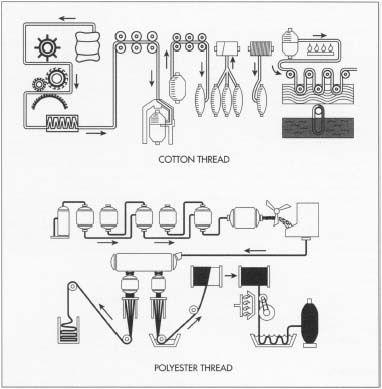
Cotton is a widely used material, it has been in use for hundreds, if not thousands, of years, and I think everyone has a basic idea of where it comes from. Polyester however, while just as widely known and used, has a more cloudy trail to it's origins. Cotton is grown, sown, separated, washed, mixed, cleaned, combed, carded, twisted, and spun. It is then woven into a fabric. 


Cotton thread is produced from large cotton bales that are cleaned, combed, carded, twisted, and spun. Polyester thread is derived from petroleum that has gone through a cracking process. During the cracking process, crude oil is broken down into a number of components that will be processed into a range of products from gasoline to plastics including polyester. Xylene, a hydrocarbon compound, is generated during cracking. Nitric acid and glycol are added to modify the xylene by a series of chemical reactions. The fluid is heated and condensed in an autoclave, and the molecules align to form long molecules called polyester. The resulting mass is extruded, cooled with water, and cut into chips. These chips are shipped from the refinery to the thread manufacturer for spinning.
photo credit :http://www.madehow.com/images/hpm_0000_0005_0_img0174.jpg

Polyester, on the other hand, came about in a laboratory within the last century. It is a silk-like material made of synthetic plastics. The name itself, while widely used, is simply a chemical composition. "Poly" means many. "Ester" is a basic organic (containing carbon, hydrogen, and oxygen) compound. Below is the structural formula for an ester. To translate for those not versed in organic chemistry (as the general populace is not), "O" is an oxygen molecule. "C" is a carbon molecule. The double lines between the "C" and the "O" are referring to a double bond, a type of chemical bond where two electrons are being shared. The single lines refer to the sharing of a single electron. The R refers to another ester in the chain, or another chemical that is bonded to the ester. The actual formula for the material we generally refer to as "polyester" is thus:
(C6H4)(CO2CH3)2 + 2 C2H4(OH)2 → 1/n {(C6H4)(CO2)2(C2H4)}n + 2 CH3OH


File:Ester-general.svg
photo credit: public domain. retrieved from http://en.wikipedia.org/wiki/File:Ester-general.svg

What all that means in English is that there are chains of the above chemical compound that link to each other, forming threads through a chemical process involving heating, cooling, stretching, and extruding. Those threads are then spun into spools, which can be used very much like cotton strands. The type of chemical bond between the elements indicates a resistance to degradation, making polyester a ideal material for durability, sun resistance, and ultimately, comfort. 

Now, once you have these threads, you can weave them together to form a fabric. In this case, "Oxford", the style of my shirt, is actually a fabric style, referring to how the fibers were woven together, shown below:


oxford-weave.jpg

photo credit: http://www.teonline.com/articles/oxford-weave.jpg

This specific weave makes the shirt strong, lightweight, and soft. Now, I could then go on to the vicissitudes of who actually makes the shirt, their working conditions, etc, but for my purposes, I was more interested in the materials themselves. Where this relates to farming is thus: Cotton obviously comes from a farm. Both the esters and the alcohol for polyester, however, are derived from petroleum oil. The dyes to color the clothes were once derived from substances grown on farms, but are generally chemically produced at this point. However, the idea to use polyester as a material for clothing production was derived from the ages old tradition of weaving silk into clothing, so the ideas of using synthetic fiber to form clothes, and the processes of how it is woven after it is produced link back to silk, wool, and cotton farmers.

Saturday, January 18, 2014

Seeds or Roots

Hello all! First post here... and I am HAPPY to be here.

Well, now that that is out of the way; let's get to the meat. My family history certainly involves farming and homesteading. The most recent of those would be my sister, but I want to know the whys and hows. Second to her, my family has been involved in agriculture on a at least an extremely small scale, with multiple family gardens among multiple relatives (home-grown veggies are the best!). Go back a little further, however, you get multiple relatives who are farmers at the "great" level. While I don't know of any life changing stories from farming, and the farming practices, it is interesting to me to learn that I am related to so many farmers. My family has always had a strong work ethic, and I have to wonder if that was passed down through generations of farming and hard work. My great great grandpa Amos Hawks was a farmer. One of the ways that farming history affected my family was the fact that they moved around a lot. Amos was restless by nature, but you have to wonder if the droughts in the late 1880's were part of the cause. Even though Amos did not live in the Great Plains (he migrated between Arizona, Utah, Nevada, and Idaho), news surely would have traveled to him, and as a farmer, he would have been seeking the most fertile soil. When his son Eardley was about 18 (in 1914), the family farm was in Fallon, NV. This was an extremely fertile area, and crops grew readily. They also raised turkeys on their land. While there is no mention of a financial rift, Eardley, who mentions often in his family history how much he loved farming, became a plasterer (probably the equivalent of a professional drywall tradesman now). From the reading, we learn that in the early 1910's, farming credit became an increasing problem, and we know from history that the great depression in the 1920's hit farmers extremely hard, where many of them had to change professions. From 1921 to 1940, there was a great agricultural depression, which is very likely why my family left farming. My great grandpa Eardley was in his early 20's up to his 40's during that time, which explains why his profession is so different from his dad's, as supporting a family as a farmer was extremely difficult. The trade of being in construction passed down to my grandpa, who was a bricklayer and eventually a contractor, and my father, who is a structural engineer.

It is interesting to now understand at least one reason why the divergence in careers from my ancestors, who were farmers by trade, to my current family tradition of finding the "best" work for yourself!

references:

http://www.agclassroom.org/gan/timeline/index.htm

https://familysearch.org/photos/stories/1560822?returnLabel=Eardley%20Erastus%20Hawks%20(KWZX-WZ7)&returnUrl=https%3A%2F%2Ffamilysearch.org%2Ftree%2F%23view%3Dancestor%26person%3DKWZX-WZ7%26spouse%3DKWZX-WZQ%26section%3Dstories