Saturday, February 15, 2014

Farming roots of Country Music: Carrie Underwood

I Ain't in Checotah Anymore by Carrie Underwood on Grooveshark
Country music means a lot of things to a lot of people. Some people instantly cringe when they hear the drawl and fiddle, some people jump up and start singing along. Personally, I have had multiple experiences with it. I used to despise country music, somewhere along the line, I started tolerating it, and now I actually have a few favorites from the genre. Carrie Underwood is one of my favorite artists. A lot of her music has heavy influence from her upbringing in rural Oklahoma. This is especially apparent in her song "I Ain't in Checotah Anymore" In this song, she makes a lot of stark contrasts between what she is used to in her earlier rural life, and her current "big city" stardom. On the other hand, I have a slightly backwards experience, from moving from a largely populated area with 5 lane freeways and malls and shopping centers to rural Roosevelt. 

A "reading" of Miss Underwood's song includes many comparisons to rural, agrarian America to industrialized, densely populated America. She talks about the distance you need to travel to go from a "local" store to home "on any given night, we'd drive a hundred miles between the Sonic and the grocery store.." This sounds like an exaggeration, however, when you live in a rural/agrarian community, you learn pretty quickly that is quite likely fact. Where I live, you have to drive 25 miles one way to get to a Wal-mart, and well over 120 miles to get to a shopping mall. The line "My hotel in Manhattan holds more people than my town, and what I just paid for dinner would be a down payment on a house" indicates the sparse population density of the home she is used to, as well as the lower cost of living that is often associated with a agrarian community. While there are many factors that are involved in determining housing costs, one of them is population density, as well as desirability of living. To give an idea of price differences, housing prices in Hollywood, Ca, Manhattan, NY, and Checotah, Ok are all vastly different, with an median price from low to high being $100,000 (Checotah), $566,400 (Hollywood), and $1,155,600 (Manhattan). The cost of living in any area is often tied to the home values, as what people can afford limits what is available for purchase in local stores. As farming tends to be a lower income source of employment, it makes sense that Checotah would be less than a tenth in the price market for housing. 


All in all, many country songs are a strong source of current folklore, which speak a lot of various aspects of farm living, whether it be culture, ideology, mechanisms of survival, or simply expressions about the difference between "them city folk" and "good 'ol country folk"

References:

Carrie Underwood. "I ain't in Checotah Anymore." Some Hearts. Sony Music Records (Arista), 2005. CD/MP3
"Home values for Checotah, Ok." zillow. Yahoo!-Zillow Real Estate Network, n.d. Web. 14 Feb 2014
"Home values for Hollywood, Ca." zillow. Yahoo!-Zillow Real Estate Network, n.d. Web. 14 Feb 2014
"Home values for Manhattan, NY." zillow. Yahoo!-Zillow Real Estate Network, n.d. Web. 14 Feb 2014

Saturday, February 1, 2014

Ashes to ashes, dust to dust, dimethyl terephthalate, ethylene glycol, and alcohol to.... polyester?


In my profession, looking sharp is an absolute essential. While there are varieties of dress codes across varying financial industries, financial institutions, and even within a specific company, the bottom line is a need to look professional. In my case, the institution I work for has a two season dress code. In spring/summer/early fall, we wear polos and khakis. In late fall/winter, we wear dress shirts and ties. While I love the comfort of a polo, I secretly love how I look in a shirt and tie. My style is solids/solids, and I have some dang good combinations. Here is my current favorite: (needs to be ironed/washed)


Now, as we are supposed to choose something we wear or eat, and as this would be difficult on my digestive system, I think it is fairly obvious what route I am taking.

Now the composition of this shirt/tie combo is:
Tie: 100% Polyester
Shirt: 45% Polyester, 55% Cotton
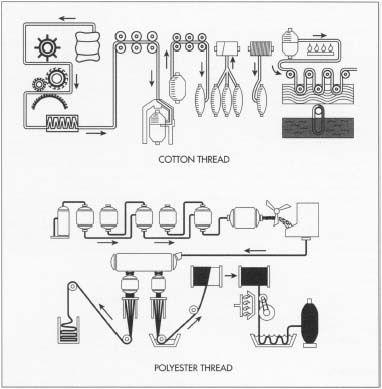
Cotton is a widely used material, it has been in use for hundreds, if not thousands, of years, and I think everyone has a basic idea of where it comes from. Polyester however, while just as widely known and used, has a more cloudy trail to it's origins. Cotton is grown, sown, separated, washed, mixed, cleaned, combed, carded, twisted, and spun. It is then woven into a fabric. 


Cotton thread is produced from large cotton bales that are cleaned, combed, carded, twisted, and spun. Polyester thread is derived from petroleum that has gone through a cracking process. During the cracking process, crude oil is broken down into a number of components that will be processed into a range of products from gasoline to plastics including polyester. Xylene, a hydrocarbon compound, is generated during cracking. Nitric acid and glycol are added to modify the xylene by a series of chemical reactions. The fluid is heated and condensed in an autoclave, and the molecules align to form long molecules called polyester. The resulting mass is extruded, cooled with water, and cut into chips. These chips are shipped from the refinery to the thread manufacturer for spinning.
photo credit :http://www.madehow.com/images/hpm_0000_0005_0_img0174.jpg

Polyester, on the other hand, came about in a laboratory within the last century. It is a silk-like material made of synthetic plastics. The name itself, while widely used, is simply a chemical composition. "Poly" means many. "Ester" is a basic organic (containing carbon, hydrogen, and oxygen) compound. Below is the structural formula for an ester. To translate for those not versed in organic chemistry (as the general populace is not), "O" is an oxygen molecule. "C" is a carbon molecule. The double lines between the "C" and the "O" are referring to a double bond, a type of chemical bond where two electrons are being shared. The single lines refer to the sharing of a single electron. The R refers to another ester in the chain, or another chemical that is bonded to the ester. The actual formula for the material we generally refer to as "polyester" is thus:
(C6H4)(CO2CH3)2 + 2 C2H4(OH)2 → 1/n {(C6H4)(CO2)2(C2H4)}n + 2 CH3OH


File:Ester-general.svg
photo credit: public domain. retrieved from http://en.wikipedia.org/wiki/File:Ester-general.svg

What all that means in English is that there are chains of the above chemical compound that link to each other, forming threads through a chemical process involving heating, cooling, stretching, and extruding. Those threads are then spun into spools, which can be used very much like cotton strands. The type of chemical bond between the elements indicates a resistance to degradation, making polyester a ideal material for durability, sun resistance, and ultimately, comfort. 

Now, once you have these threads, you can weave them together to form a fabric. In this case, "Oxford", the style of my shirt, is actually a fabric style, referring to how the fibers were woven together, shown below:


oxford-weave.jpg

photo credit: http://www.teonline.com/articles/oxford-weave.jpg

This specific weave makes the shirt strong, lightweight, and soft. Now, I could then go on to the vicissitudes of who actually makes the shirt, their working conditions, etc, but for my purposes, I was more interested in the materials themselves. Where this relates to farming is thus: Cotton obviously comes from a farm. Both the esters and the alcohol for polyester, however, are derived from petroleum oil. The dyes to color the clothes were once derived from substances grown on farms, but are generally chemically produced at this point. However, the idea to use polyester as a material for clothing production was derived from the ages old tradition of weaving silk into clothing, so the ideas of using synthetic fiber to form clothes, and the processes of how it is woven after it is produced link back to silk, wool, and cotton farmers.